A Global Examination of the ‘Welfare Magnet Hypothesis’ Using ERGMs
The question of whether welfare generosity in destination countries attracts migrants has sparked decades of debate. Commonly referred to as the ‘Welfare Magnet Hypothesis’ (WMH), this theory suggests that migrants are drawn to countries with robust welfare systems. However, does this assumption hold up under scrutiny? Our latest research employs Exponential Random Graph Models (ERGMs) to explore this complex dynamic on a global scale, focusing on migration flows between 160 countries.
Read the open access peer-reviewed article here. You can also download the (pre-review) working paper here.
Revisiting the Welfare Magnet Hypothesis
Previous studies on the WMH have often been limited to migration flows into or between OECD/EU countries, neglecting flows between other regions. The WMH assumes a maximization motive behind migration—individuals purportedly migrate to countries offering the highest economic and welfare benefits. Yet, this view oversimplifies a highly nuanced phenomenon, potentially overestimating the pull effect of welfare systems.
Our research aims to challenge these assumptions by adopting a network perspective, capturing dependencies between migration flows often overlooked in traditional models. This approach sheds light on:
- The interaction between welfare systems and migration flows.
- Structural dependencies that influence global migration networks.
Methodology: A Network Perspective

Data
We analyzed migration flows using migrant stock data from the UN Migration Database (2019). Flows were defined based on significant migration ratios (“Sent-to-alter/population-at-home ratio”) and included structural network terms to account for dependencies between flows.
Variables of Interest
- Welfare Generosity: Social and health care expenditures as a percentage of GDP.
- Control Variables: GDP per capita, population size, democracy scores, geographic distance, shared languages, and bilateral agreements.
- Preferences: Migration preferences aggregated from the Gallup World Poll (2008-2009), comparing low- and high-income groups.
Models Used
We utilized ERGMs to predict migration flows, incorporating:
- Gravity model variables (e.g., GDP, distance).
- Network terms (e.g., reciprocity, transitivity).
- Mediation analysis to explore the role of migration preferences.
Key Findings
Welfare Generosity and Migration Flows
- Destination Effects: Contrary to the WMH, higher social expenditures in destination countries did not significantly attract migration flows. Health care spending exhibited a small positive effect but was marginal in magnitude.
- Origin Effects: Higher social expenditures in origin countries reduced outflows, suggesting that robust welfare systems may serve as a deterrent to emigration.
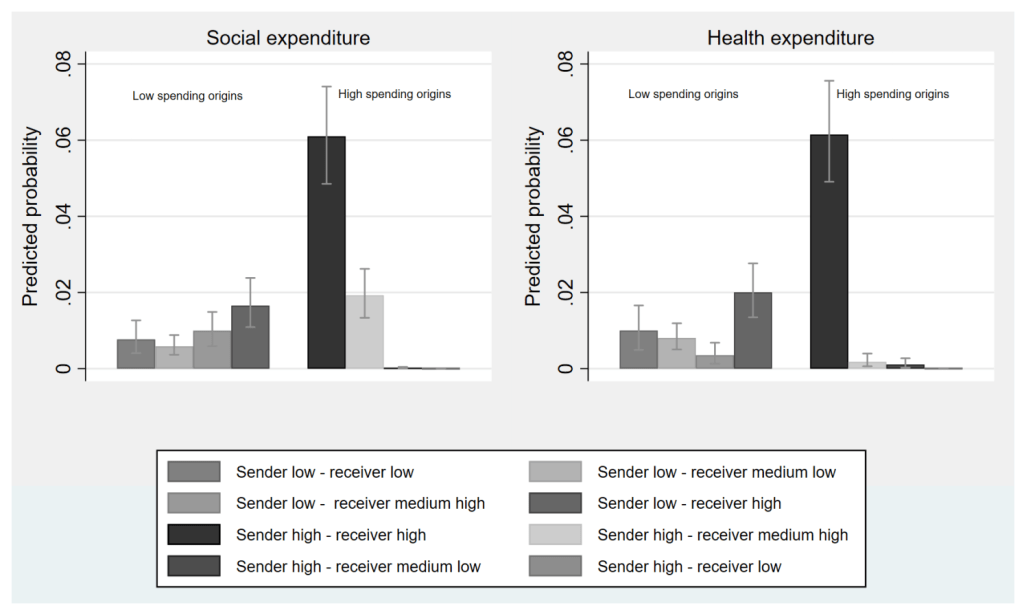
- Status Maintenance: Flows were more likely to occur between countries with similar levels of welfare spending, aligning with a status maintenance motive rather than maximization of welfare benefits.
Role of GDP and Population Size
- GDP per capita and population size were the most consistent predictors of migration flows. These easily observable characteristics appear to shape migration decisions more strongly than welfare policies.
Migration Preferences
- Migration preferences, particularly for low-income groups, did not align with expectations of the WMH. Preferences for democratic governance and economic opportunities outweighed considerations of welfare generosity.
- High-income respondents exhibited more global migration patterns, while low-income respondents tended to migrate to geographically closer destinations.
Implications and Conclusions
The findings suggest that the WMH has been overstated in previous literature. While welfare systems may play a role in shaping migration decisions, their effects are overshadowed by more salient factors like GDP, population size, and democratic governance.
Policy Implications:
- Debunking the WMH: Policymakers should reconsider the narrative that reducing welfare benefits will deter migration. Such measures may have limited effects on migration flows but significant negative social consequences.
- Focus on Retention: Welfare policies may be more effective in retaining migrants and ensuring their long-term integration rather than influencing initial migration decisions.
- Global Migration Dynamics: Future migration policies should account for structural dependencies and regional dynamics rather than assuming independent migration flows.
In conclusion, migration flows are more complex than a simple “welfare magnet” narrative. Understanding the interplay of economic, social, and political factors is essential for designing effective migration policies.
 Tim Müller – Data Scientist and Social Researcher